
KeyBank Foundation’s commitment of $100,000 per year over 3 years will support the development of Mass Insight’s new AP Pathways Program. October 19th, 2026 – Boston – Mass Insight Education & Research has been selected as a recipient of KeyBank Foundation’s...
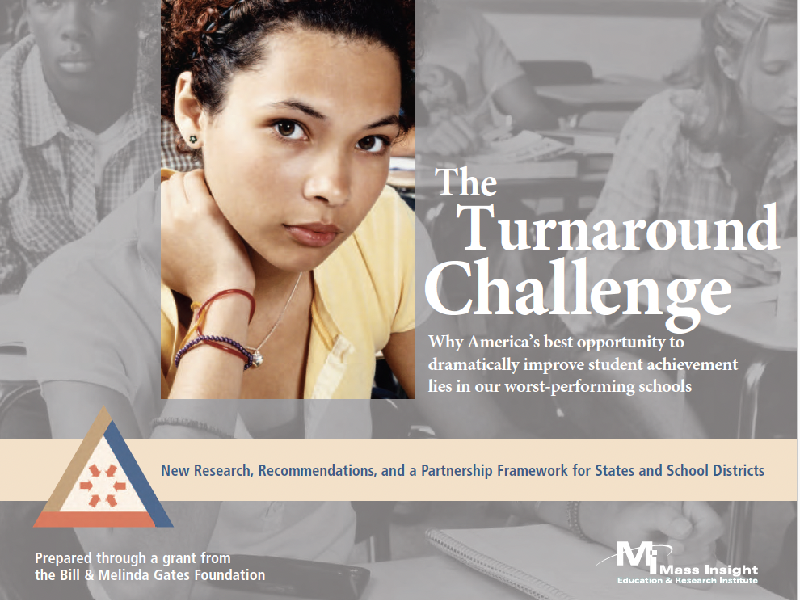
The Turnaround Challenge
The Turnaround Challenge was published in November 2007. To date, more than 200,000 copies of the main report have been downloaded, and the report’s framework is being used to develop turnaround strategies in dozens of schools, districts and states, and is informing federal policy as well.
Download the Resource
Recent Posts
Habits Over Gaps: A New Path to Algebra Readiness
“My class can’t do grade level work. My students can’t multiply. I need to teach multiplication first,” said a middle school math teacher during a recent PD session. Math teachers face this challenge every day: students arrive in their classrooms with...
The Math Crisis is Real. The Solution Starts in Middle School.
Your child gets into a great university. Soon after, the first placement test comes back, and they’ve been assigned to a class covering middle school math. This is not a hypothetical. One of the most talked about data points right now comes from a new...
You may also like
All Over The Map: Massachusetts High School Graduation Requirements
A new report by the Voices for Academic Equity Coalition, of which Mass Insight is a founding member, unpacks the status of the state’s MassCore curriculum, a recommended opt-in course of study for the state’s high school students. Massachusetts currently has just...
Executive Summary: Revisiting The Turnaround Challenge
Our report, Revisiting The Turnaround Challenge: Lessons From the Field to Advance Pandemic Recovery in Low-Performing Schools, takes a look back at the Zone model presented in our seminal 2007 report, The Turnaround Challenge, and uses three anonymous district case...
Revisiting The Turnaround Challenge: Lessons From the Field to Advance Pandemic Recovery in Low-Performing Schools
It has long been the case that the nation’s lowest performing schools serve our highest needs students — students who are systemically marginalized by virtue of race, ethnicity, socioeconomic status, language, and/or ability. But the COVID-19 pandemic has exacerbated...