
Ms. Wolfe succeeds Dr. Susan Lusi, who will step down in June after leading the national nonprofit for eight years. April 18, 2024 – The Board of Directors of Mass Insight Education & Research has named Andrea Wolfe as the next President & CEO of the...
What leads to greater impact – resource infusion or focused, aligned capacity building? — Lesson Five From Revisiting the Turnaround Challenge
This is the fifth of seven blog posts that will highlight the key points in Mi’s recent report, Revisiting the Turnaround Challenge. The report examined the outcomes of three “turnaround zones” implemented by urban public school districts in partnership with Mi between 2012-2019. Our goal was to learn from our past work to help school and district leaders and State Education Agency staff accelerate pandemic recovery in low-performing schools and begin the difficult task of reinventing public education to better serve systemically marginalized students.
The Turnaround Challenge maintains that building capacity is a critical component of effective turnaround, and the districts we studied approached the task of building capacity in zone schools differently. Whereas two districts built capacity by flooding their zones with resources in the form of additional staff, the most successful zone built capacity through systems and structures designed to help school leaders learn to align their actions and goals. In this district, zone leaders helped principals develop strong school improvement plans focused on a limited number of priorities with clear measures of success. They also used spreadsheets, tracking tools, and regular meetings to monitor the progress of plan implementation and discuss the extent to which their activities were aligned to their priorities and helping to achieve their goals. Notably, only the latter district experienced sustained improvement to student test scores in zone schools.
Over the decade and a half since The Turnaround Challenge was released, Mi’s capacity-building efforts have helped many partners improve their ability to identify a limited number of high-leverage priorities, establish leading and lagging indicators and supportive mechanisms for enabling partners to determine if they are on-track, and course correct if they are not.
In the spring of 2023, Mi collaborated with the Evansville Vanderburgh School Corporation (EVSC), a longtime partner, in Evansville, Indiana to support their focus on equitable outcomes in schools by performing a deep dive into their Office of Special Education. One of the high-leverage priorities identified was a need to increase the quantity and quality of inclusive grade level instruction happening for students with disabilities alongside their non-disabled peers. We now support school leaders in four EVSC schools in aligning their instructional structures and support their goal of increasing student achievement for students with disabilities.
With one school, we began by supporting the leadership team as they conducted a root cause analysis of their achievement data and data about the number of students with disabilities learning alongside their non-disabled peers, all disaggregated by student subgroups, to define a school priority of increasing the amount and quality of planning support provided to teachers in co-taught classrooms. We then used alignment protocols, which focus on connecting strategies to outcomes, to help the principal determine the best indicators to monitor progress. These included evidence of the quality of general and special education teachers’ co-planning as well as the impact of that instruction on student success during classroom observations. As we support this principal, we will focus on designing and implementing leadership team meetings that focus them on analyzing their observation data around their leading indicators and to adjust course when they are off track.
While we are early in this work, we have already seen changes in school conditions in the EVSC. For example, in the school described above, work has already begun to create more co-planning time in the schedule, using research-based protocols to elevate the planning general and special education teachers do to support all students in their classrooms. School leaders will observe those spaces in order to determine if they are on track to producing the kind of lesson plans that will support the learning of students with disabilities in the general education setting.
Mass Insight develops the leadership and change management capacities of leaders closest to the work of school improvement. Over 25 years of doing this work has taught us that leaders with a clear focus and supportive mechanisms to check on progress are crucial for long-lasting success.
Click here to read the next blog post in this series.

Recent Posts
Mass Insight Launches New Service to Tackle Chronic Absenteeism
The Targeted Intervention: Chronic Absenteeism will take a community-based exploratory approach to understanding the experiences of chronically absent students and efforts to increase student attendance. March 18, 2024 – Mass Insight Education & Research...
An Interview with Kristen Hengtgen of The Education Trust
https://youtu.be/1ZfxNShHJOU?si=d1a1GoVrgrDWT5Cu Kristen Hengtgen, Ph.D. is a senior analyst on The Education Trust's P-12 policy team and co-author of their new report, Increasing Access to Advanced Coursework in Massachusetts. In this interview, she joins Mass...
You may also like
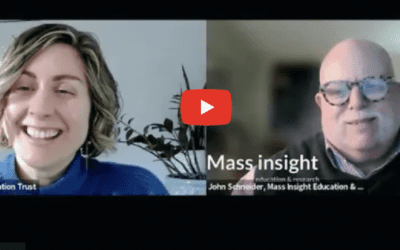
An Interview with Kristen Hengtgen of The Education Trust
https://youtu.be/1ZfxNShHJOU?si=d1a1GoVrgrDWT5Cu Kristen Hengtgen, Ph.D. is a senior analyst on The Education Trust's P-12 policy team and co-author of their new report, Increasing Access to Advanced Coursework in Massachusetts. In this interview, she joins Mass...

Creating the conditions for greater success of systemically disadvantaged students in AP: Next steps for the Massachusetts AP STEM & English program
Recently the New York Times published an article entitled, Why is the College Board Pushing to Expand Advanced Placement? The article focuses on an important issue: there’s been greater growth in AP participation for Black and Latino students and students living in...
Recentering Our Communities in School Transformation: An Equity-First Approach
This is the final post in Mi’s Revisiting the Turnaround Challenge blog series. In Revisiting the Turnaround Challenge, we examined the outcomes of three “turnaround zones” implemented by urban public school districts in partnership with Mi between 2012-2019. Our goal...